Its Semiquincentennial
Eighth in the Series
Aaron Goodwin
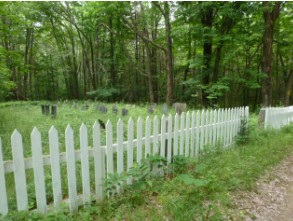
This month we continue with the second of the four Patriots buried in the Burbank-Goodwin-Morrison-Pease Cemetery.
Aaron Goodwin was born to Aaron (1702 – 1771) and Sarah Thompson Goodwin (1715 – 1769) on August 18, 1754, in Berwick, Maine.
He enlisted in Massachusetts about the 1 st of January 1776 and served one year in Captain Phillip Hubbard’s company of Colonel Pierce Long’s New Hampshire regiment and was stationed at Kittery Point, York County, Massachusetts which later became Maine.
Thanks to this request for information sent to the Bureau of Pensions in 1934, we learned of his later service.
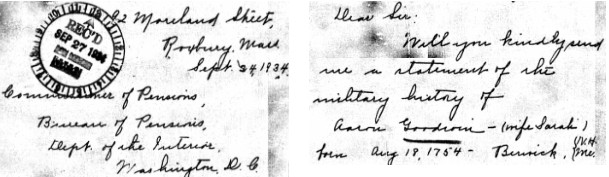
In addition to his previous service the record continues that in April of 1779, at a port in France he was a seaman on board the United States ship, Bonhomme Richard captained by none other than Captain John Paul Jones and was in its famous engagement with the Serapis.
I must admit that what I remembered from this part of our Revolutionary history was a bit sketchy. Perhaps yours is as well, so a little refresher is in order.
This sketch about John Paul Jones comes from The Naval Marine Archive – The Canadian Collection.
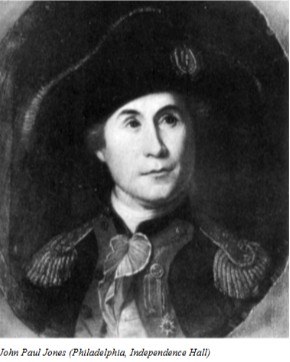
Born John Paul on July 6, 1747 in Arbigland, Kirkcudbright, Scotland he started a maritime career at the age of twelve or thirteen. His early life included two years aboard slavetraders, and killing a mutinous sailor over a wage dispute. Fleeing Great Britain and changing his name to John Paul Jones, he turned his allegiances towards the Revolutionary War in North America (the fledgling United States) and France, becoming a successful officer in the Continental Navy. Regarded by some as the “father of the American Navy”, by others as a mercenary privateer, his greatest success was the capture of the British SERAPIS (140 foot Fifth Rate, 44 guns) in 1779. He joined the Imperial Russian Navy as a Rear-Admiral in 1787, and died 18 July 1792 in Paris.
In this from the Naval and Heritage Command we learned more about the ship:
The Bonhomme Richard, a former East India merchant ship re-fitted as a frigate capable of carrying 40 guns, was captained by John Paul Jones. In the late summer of 1779, it operated in waters off the coast of Great Britain in the North Sea.
Jones’ mission was to interrupt British merchant shipping and execute hit-and-run raids on British ports to instill fear in the population. On September 23, 1779, Bonhomme Richard and two other frigates encountered HMS Serapis (50 guns), commanded by Captain Pearson, and a smaller British warship with a convoy of 41 ships. Jones engaged the heavier-gunned Serapis. During the fierce fight, the two warships collided and Jones lashed his vessel to Serapis while each continued to batter away at the other. Jones’ crew panicked at the destructive Serapis fire and yelled “Quarter” to the British. Pearson called out “Have you struck your colors?” to which Jones purportedly replied, “I have not yet begun to fight!” After a four-hour battle under a full moon, Serapis surrendered. Both ships had suffered extensive damage, and each lost nearly half its crew to injuries and death; Bonhomme Richard sank two days after the battle. The victorious John Paul Jones sailed the captured HMS Serapis to Holland for repairs. Jones rechristened the previously British vessel and presented it to the French as a show of friendship.
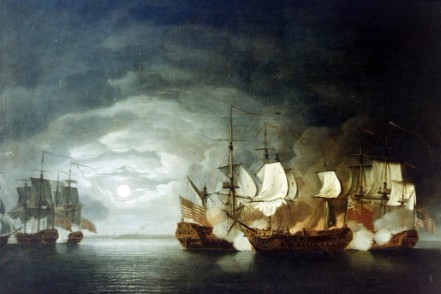
Battle between Continental Navy ship Bonhomme Richard and
HMS Serapis, 23 September 1779. by Thomas Mitchell.
The original painting is at the U.S. Naval Academy Museum in Annapolis, Maryland.
According to the pension record, after the sinking of the Bonhomme Richard and after John Paul Jones and his crew took possession of the Serapis and sailed to Holland where they left the Serapis for repairs, they went on board the United States ship, Alliance, and sailed to Coronna, Spain.
From there they sailed to L’Orient, France, where Captain Landais took
command of the Alliance and Aaron Goodwin sailed with him to Boston and was discharged there after his arrival in August, 1780.
What an interesting story! Sounds like Aaron was lucky to escape injury or, even worse, death. He must have been so happy to be home.
He married Sarah Hubbard, daughter of the Captain of his first enlistment, Phillip Hubbard, on March 21, 1787, in his hometown of Berwick.
They had at least these children during their marriage: Lewis (b. 1787), Moses (b. 1789), John (b. 1790. d. 1809), Aaron (b. 1793. d. 1806) and Sally (b. 1795).
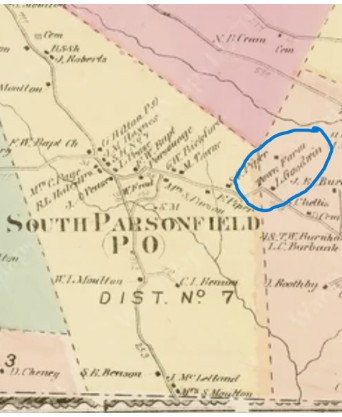
According to the History of Parsonsfield, he settled on the so-called South Road in 1796 when he bought the property of Moses Mighels. I have not been able to ascertain the location of the property, but the 1872 map of Parsonsfield shows a L. Goodwin just south of the Town Farm on South Road in South Parsonsfield which is a possibility as Aaron’s son, Lewis, was still alive at the time, not dying until 1878.
Both the Maine Old Cemetery Association Index of Revolutionary Veterans Buried in Maine and Soldiers, Sailors and Patriots of the Revolutionary War – Maine indicate that Aaron was married twice.

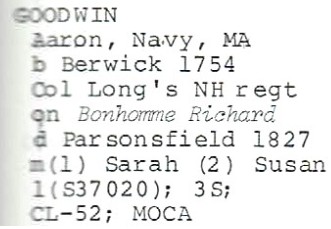
This really had me baffled because I could find nothing to corroborate that and, in fact, his wife Sarah actually outlived him, dying in 1835.
Then I noticed this in the cemetery’s Goodwin family listing from Cemetery Records, Parsonsfield, Maine reproduced by Ancient Landmarks Society of Parsonsfield, 1991:
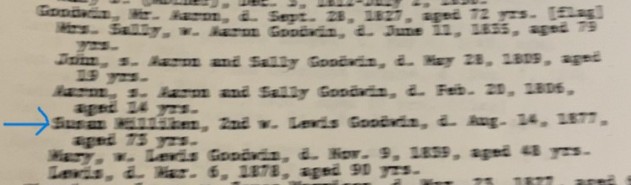
Mystery solved. Susan Milliken was the second wife of Aaron’s son, Lewis, not of Aaron.
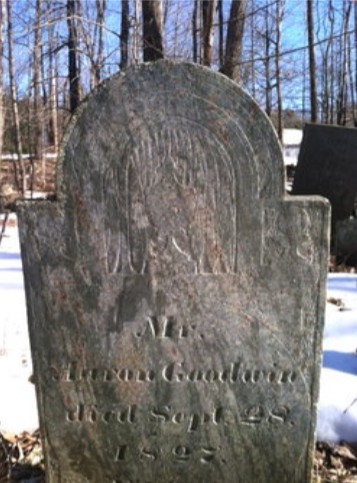
Aaron died on September 28, 1827, in Parsonsfield, Maine, at the age of 73.