Category Archives: Uncategorized

7/15/2026–Celebrating the 250th anniversary of the founding of our Country,

Its Semiquincentennial
Seventh in the Series:
Silas Burbank

I was very interested to find that this cemetery, located in the SW angle of the intersection of South and Boothby Roads and opposite the former Town Farm, contains the remains of four Revolutionary War veterans. The Maine Old Cemetery Association, MOCA, lists it as the Burbank-Goodwin-Morrison-Pease Cemetery, honoring the names of all 4 of those patriots:

Silas Burbank
Aaron Goodwin
James Morrison
Samuel Pease

I was intrigued at this point. Had any of them known each other before or during the war? It seemed logical to learn and write about them in alphabetical order so I began my research into Silas Burbank.

Captain Silas Burbank was born to Caleb Burbank and Margaret Wheeler in 1738 in Rowley, Essex County, Massachusetts. Silas was trained as a carpenter, specializing in cabinet making and wood work finishing of fine ships.

Silas was united in marriage to Hannah Baird in approximately 1763. Caleb and Hannah lived for a while in Falmouth, what is now Portland Maine, before settling down in Scarborough. They were blessed with the birth of at least eight children during their marriage.

In 1775 Silas enlisted as a First Lieutenant in Captain John Rice’s Company in Col. Edmund Phinney’s 31st Regiment in the 18th Continental Regiment of Scarborough, Maine in 1776. He was promoted to the rank of Captain and served in the Army at Valley Forge until 1781.

At about this point in developing Silas’ story, I was surprised to see this ad in our local weekly, Your Weekly Shopping Guide.

I was dumbstruck. I knew right away that this had to be the same Silas Burbank, but had not yet learned about him bringing 2 of his young sons along as fifer and drummer.

I wish I had been able to attend this. I’m sure I would have learned more about this remarkable story.

For more information, I turned to one of my much used sources, Soldiers,
Sailors, and Patriots of the Revolutionary War – Maine
. And there his sons were, along with their father’s listing:

The letters and numbers at the end of these listings are the cited references.

David’s only reference is:

  • MOCA (Maine Old Cemetery Association).

Eleazer has several references:

  • 1 (W23744) – Massachusetts Soldiers and Sailors of the Revolutionary War 17 v.
  • 1S – Massachusetts Archives, Revolutionary War Service Appendix
  • 3S – Flagg’s Alphabetical Index of Revolutionary Pensioners Living in Maine
  • 4S – Maine State Archives – Names of Soldiers of the American Revolution Who Applied for State Bounty …
  • CL-2, 141:133 – Compiled List – Lineage Book, 166 volumes.

Captain Silas also has several references:

  • 1S – Massachusetts Archives, Revolutionary War Service Appendix
  • 6S, p. 181 – History of Col. Edmund Phinney’s 31 st Regiment of Foot: The First Regiment Raised in the County of Cumberland in the Revolutionary War
  • CL-2, 141:133 – Compiled List – Lineage Book, 166 volumes.
  • CL-6 – Compiled List – Historical Register of Officers of the Continental Army during the War of the Revolution, April, 1775 – December, 1783.

It’s hard with our modern day sensitivities to imagine taking young sons off to war. Perhaps he thought it was the easiest way to watch over them. Many young men, not that much older than 11 and 13, did head off to battle.

Historically, a fifer was a non-combatant military personnel—often a young boy or teenager—tasked with playing the fife alongside drummers to relay orders, maintain a marching pace, and signal troop formations.

Drummer boys in the Revolutionary War were young field musicians (often 10 to 15 years old) who used rope-tension drums to relay tactical commands across loud, smoky battlefields. They set the army’s daily routine, regulated marches, and boosted morale, often serving alongside adult musicians and soldiers.

Silas’ listing in the book, Massachusetts, U.S., Soldiers and Sailors in the
Revolutionary War gives a much more complete listing of his service than the Maine one.

Here, from the same source, is his son David’s listing:

And the listing for Eleazer:

Eleazer enlisted in the army in Scarborough for one year at age eleven and served until August when he was left in Boston with smallpox and sent home. He was a musician, a fifer,  in the company of Captain Watkins of the Regt. commanded by Col Phinney in the Massachusetts line. He and his brother, a drummer, served with their father. In January, 1777 he enlisted for 3 years and served in his father, Col. Silas Burbank’s,  company in Col. Samuel Brewer’s regiment.

One record on file in Washington states that “Eleazer was captured and held prisoner for a month and when the English soldiers asked him to play for them he responded by playing Yankee Doodle much to their amusement.

He was in the retreat from Ticonderoga, Battle of Fort Ann and at taking of Burgoyne.  In Dec, 1780 he was discharged from the military.

Neither of the brothers ended up in Parsonsfield. In 1788 Eleazer married Mary Brackett. He was a farmer and after living in Scarborough for a time, around 1798-99, he moved with a 6 ox team to Belgrade, Maine where he lived out the rest of his days.

His older brother David married Miriam _ and settled in Newfield, Maine
appearing there in the 1800 Census. He died in 1806 at the age of 44, leaving 5 minor sons.

The first of the family to move to Parsonsfield was their younger brother, Samuel, born 1772. He married Esther Boothby and they, along with his father, settled in Parsonsfield sometime around 1805. He was a blacksmith and a carpenter. When his brother David died prematurely, Samuel and Esther were appointed the legal guardians of David’s 5 young sons – this was in addition to raising their own 11 children.

The 1856 and 1872 maps show their home as that of William Burbank, who was Samuel’s youngest son.

Captain Silas died in this house in September 1814 and was buried in the afore-mentioned cemetery. His tombstone bears a lovely motif of a weeping willow with the following inscription:

In memory of Capt. Silas Burbank
died Sept. 1814 in the 76th yr of his age.

A Heartfelt Thank You to Silas Burbank
and his sons, David and Eleazer for their Service in the Founding of Our Country

3/15/2026 – Celebrating the 250th Anniversary of our Country’s Founding, its Semiquincentennial

Third in the series.

No complete list of Revolutionary Soldiers who moved to this area exists.
Perhaps it never will, but we certainly hope to be able to make a good start at creating one. In January I sent this e-mail to our PPHS President, Sylvia Trueworthy Pease. Her Revolutionary ancestor was John Trueworthy born in Biddeford in 1739.

I have been trying to find a complete list of Revolutionary War veterans
who lived in Parsonsfield but so far no luck.  I’ve been piecing a list together from various sources.  None of which show your ancestor, Sylvia.  Ancestry shows this as a possibility with the name Treworgy. Does it agree with your records?

Had Sylvia not been a part of our historical society, I may well have not become aware of John Trueworthy. Her assistance in gathering this information has been invaluable.

The Trueworthy family was originally from the Kittery area.  The original descendant bore the name of TREWORGY. James Treworgy who was originally from Brixham, Devon, England bought land in Kittery, District of Maine in 1635. He had married, Katharine, dau. of Alexander Shapleigh in Kingsweare, England, on 16 March 1616. The Treworgy family was involved in the cod fishery in New England as well as
Newfoundland.  This name became Treworthy, Truworthy and Trueworthy.

John Trueworthy was 36 years old when he enlisted on May 4, 1775.
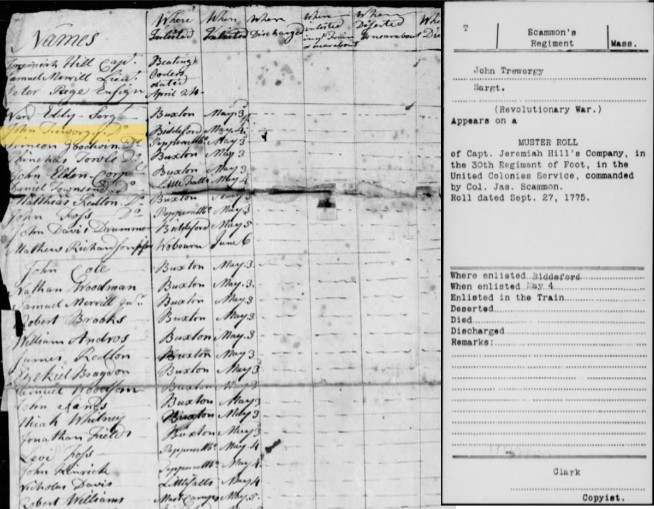
After his service he returned to Biddeford where on April 23, 1780 he married Charity Emery, his first cousin. They had the following children: Rebekah, b. 1780; Mary, b. 1782; John Jr, b. 1785; Phebe, b. 1787; Noah, b. 1791 and William, b. 1798.

The 1790 Census shows his family still residing in Biddeford but they later took up residency in Phippsburg where in 1803 John served as constable and was required to collect taxes of several people in the town. Perhaps that was not to his liking because in February of 1807 he bought a parcel of land from Benjamin Rolfe in Parsonsfield. Rolfe was the first settled minister of the town.
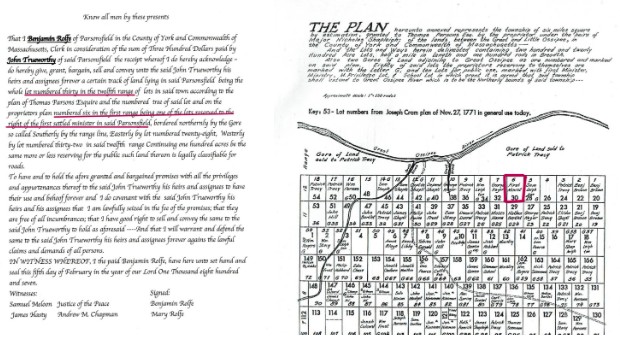
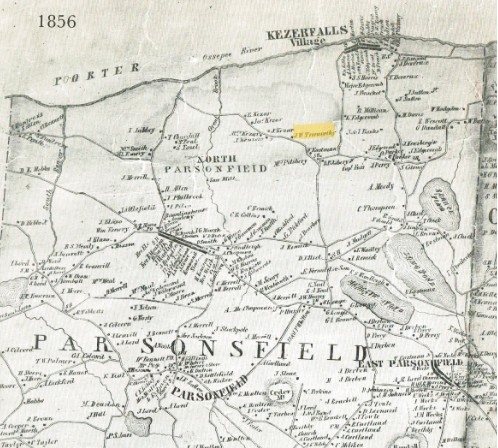
On this 1856 Map of Parsonsfield the property on Kezar Mountain Road was home to John’s grandson, Jonathan Woodman Trueworthy (1823 – 1906), the son of John Trueworthy Jr. (1785 – 1877).
This early 1900’s photo by George French shows the Trueworthy Family
in front of the family home. Nothing remains of the house today.
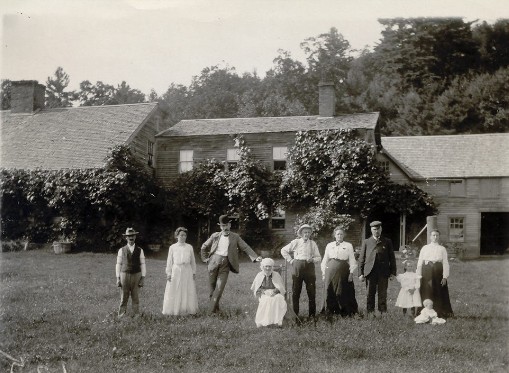
The families members, identified by Sylvia Pease, are:

Left to right: Fred Trueworthy, Helen Parker Trueworthy (married to Ralph), Ralph Trueworthy, Angeline Trueworthy (Mrs. J. W. Trueworthy), 
Uncle John Trueworthy (brother to J.W. Trueworthy), Josie Rounds, Al Floyd, Mrs. A. Floyd,  Children: Lula Floyd Whiting, Perley Floyd.

J. W. Trueworthy’s son, Elmer, and grandson, Harry also farmed here but when Harry inherited the farm he chose not to live there and moved to neighboring Porter. Our PPHS President, Sylvia Trueworthy Pease has supplied us with her lineage to John, our Revolutionary Patriot.

Her Father – Lloyd 1920-1980 married Isabel Perkins
Grandfather – Harry 1881-1952- married Minnie Wilkinson
Gr. Grandfather – Fred 1858-1937  married Imogene Holmes
Gr. Gr. Grandfather – J. W.Trueworthy 1823-1906 married Angeline Foss
Gr. Gr. Gr. Grandfather  – John Trueworthy Jr. 1785- 1877 married Olive Stone
Gr. Gr. Gr. Gr. Grandfather John Trueworthy 1739-1832 married Charity Emery

John Treworgy/Trueworthy died November 25, 1832 at the age of 93 and is buried in the Trueworthy Cemetery alongside his wife, Charity Emery Trueworthy who also lived a long life, dying in 1843 at the age of 92.

The book, “Cemeteries Records, Parsonsfield, Maine” recorded by Constance Hobbs and revised by Ancient Landmarks Society of Parsonsfield in 1982 states that the remnants of his stone has crumbled. This is the sad fact of many of the gravestones of our ancient forebears.
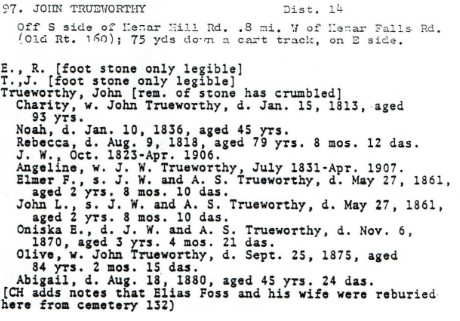
But as you can see both John’s stone and that of his wife, Charity, have been lovingly replaced. Note also that the listing in the book incorrectly gave Charity’s year of death as 1813, rather than 1843, another sad fact of the old stones being difficult to read.
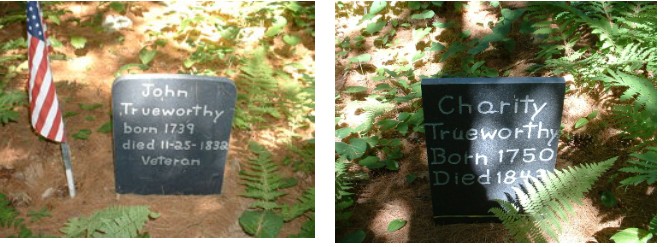
We thank you, John Trueworthy, for your service in the founding of our Country. And we thank the Trueworthy family for their care in honoring their Revolutionary Soldier ancestor.

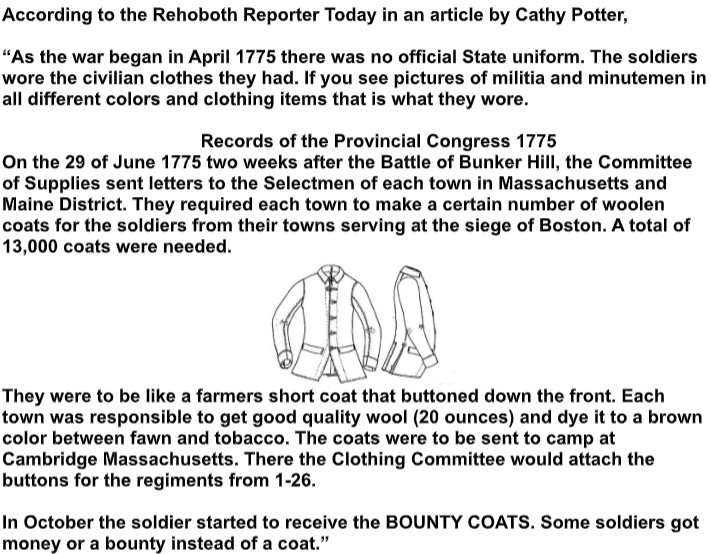
A little additional information for all you history nerds out there, like myself. Have you ever wondered what a bounty coat was?
1/15/2026 – Celebrating the 250th Anniversary of the Founding of our Country, its Semiquincentennial

1st in a series

At the time of the American Revolution this area in the Maine hinterland was, for the most part, considered too remote and inaccessible to be settled. So our hill-towns cannot boast of any native sons who fought in that conflict. That all changed with the end of the war when many of those discharged from the Continental Army decided to leave the more populated areas near the coastlines to acquire generous tracts of land
and settle down to raise families.

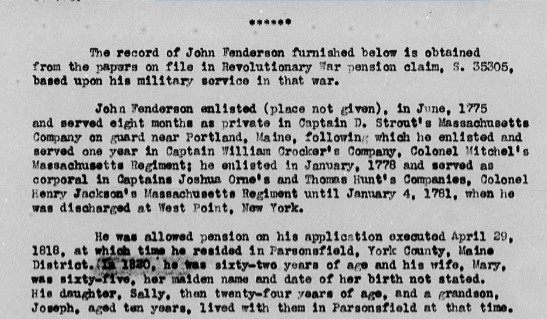
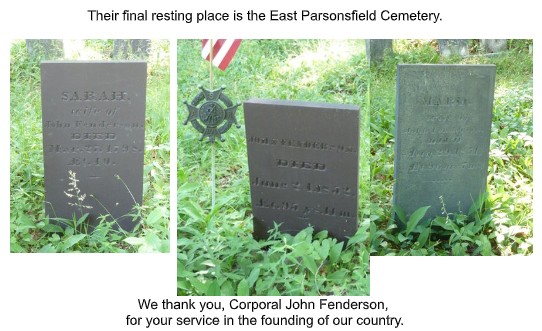
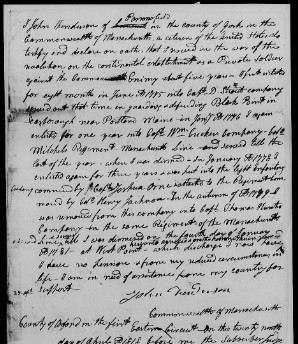
Among them was Corporal John Fenderson who had enlisted from Pepperellborough, what is now Saco. According to “A History of the First Century of the Town of Parsonsfield, Maine, 1785 – 1885”, he was born in Scarborough on July 15, 1757, though other records indicate that his birth year was 1756. He served five years in the Revolutionary War in various capacities and, at one time, Aide de camp to General Lafayette,

Above is shown his personal testimonial when applying for a war pension in 1818.

And below shows a record obtained from the Pension Department.

After his discharge, he married Sarah Kenny of Saco on November 15, 1781. She bore him six children, Polly, Nathan, Nathaniel, John, Edward, and Sally. They moved to Parsonsfield, according to the aforementioned “History of Parsonsfield” in 1795, though other records indicate an earlier date of 1792, and settled on what is now known as Cramm Road where he first built a log cabin.

His first wife, Sarah, died in March 1798 and he married 2nd Mary Milliken on March 27, 1798. Corporal John, as everyone called him, was a farmer and leading citizen. He started a sawmill and did quite a business sawing up lumber and taking it by ox team to the market in Portland, forty miles away.

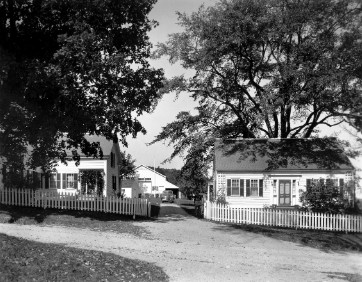
He later built a small frame building where the house on the left is located. The house on the right was built by his son, Edward, in 1843/44 who later sold it to his brother Nathan’s son, Ivory, before moving away. A short time later another building was moved here and attached in the back as an ell. When Ivory’s son, Nathan W. Fenderson, married about 1869 he moved the small building John had built and erected the house on the left. The new kitchen was placed over the small cellar hole
that existed under the old building.

Six generations of the Fenderson family called this farm home before it finally passed out of the family when the last remaining direct family member, Jose W. Fenderson, died unmarried in 2013 at the age of 98.

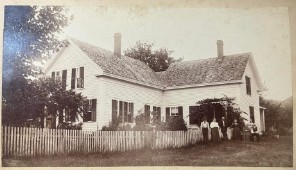
The current owners of the house found this lovely earlier picture of the house.

As related in a newspaper article of unknown date prior to 1949 by an unknown author, “the story goes that one day in 1820 as Corporal John stood in his doorway, gazing at Mt. Randall over beyond the little red schoolhouse (located nearby), a stranger rode up to his gate, dismounted and inquired if he had the good fortune to address Mr. John Fenderson, late of the army. Corporal John went out to inspect his questioner and recognized in him his old tent-mate of the old days at Valley Forge.
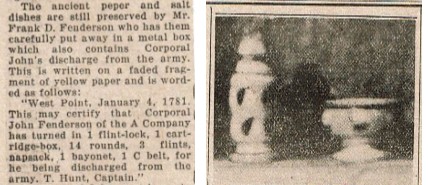
Overjoyed to see each other, explanations were soon in order as to how the stranger had ever succeeded in finding his old comrade. It seemed that he lived near Philadelphia, had come to Portland by sloop on a matter of business and, having attended to it, had resolved to hunt up his old comrade. He had hired a saddle horse and found his way to Parsonsfield and to the very home of his old friend. He stayed a day or two during which he and Corporal John rehearsed every incident of their life together in those perilous days of the war; they even got out the old salt dish and pepper shake that John had carried in his knapsack all through the Revolution and recalled how their use in those dreary days of scarce and poor food had brought to their simple camp meals a flavor of home. The two friends, so unexpectedly united, parted with sadness for they realized that in all probability they would never see each other again.” The article includes the following:

Frank D. Fenderson (1878 – 1949) was the father of Jose W. Fenderson (1914 – 2013), the last Fenderson to live at the farm. The whereabouts of these family treasures is unknown.

Corporal John died at Parsonsfield on January 24, 1852 at the age of 95. His wife, Mary, preceded him in death a few months before on
August 29, 1851 at the age of 97. In an interview with Jose Fenderson, Jose stated that family members were buried along a stone wall on the north side of the house – Corporal John along with his two wives. According to Jose when his father, Frank D. Fenderson, married his mother, Laura A. Jose in July 1905, Laura thought that burying the family in the back yard was “heathen” and the Corporal John Burial was moved.

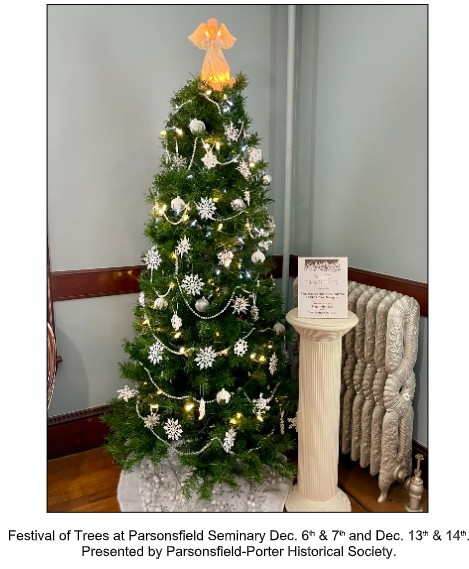
12/15/2025 – Festival of Trees!

We participated in the Par Sem Festival of Trees again this year and for our final post of 2025 we want you to see our tree.

“WHITE CHRISTMAS”

Presented By

The Parsonsfield-Porter Historical Society.

We wish all of you

Happy Holidays

and a

Wonderful New Year.

The BLOG will continue in 2026

We look forward to seeing everyone in person in the spring!