Its Semiquincentennial
Seventh in the Series:
Silas Burbank
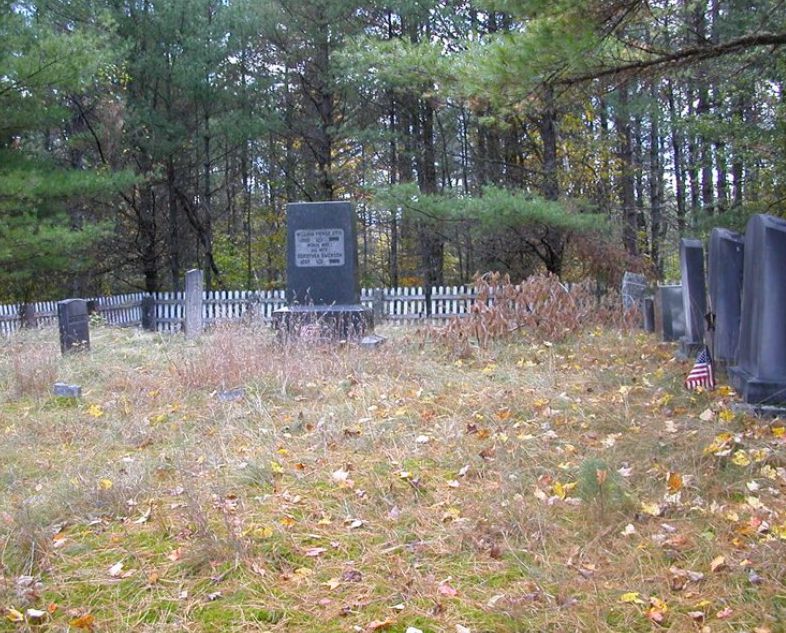
I was very interested to find that this cemetery, located in the SW angle of the intersection of South and Boothby Roads and opposite the former Town Farm, contains the remains of four Revolutionary War veterans. The Maine Old Cemetery Association, MOCA, lists it as the Burbank-Goodwin-Morrison-Pease Cemetery, honoring the names of all 4 of those patriots:
Silas Burbank
Aaron Goodwin
James Morrison
Samuel Pease
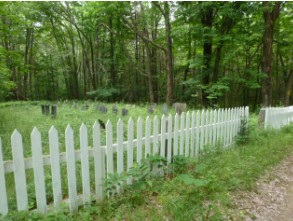
I was intrigued at this point. Had any of them known each other before or during the war? It seemed logical to learn and write about them in alphabetical order so I began my research into Silas Burbank.
Captain Silas Burbank was born to Caleb Burbank and Margaret Wheeler in 1738 in Rowley, Essex County, Massachusetts. Silas was trained as a carpenter, specializing in cabinet making and wood work finishing of fine ships.
Silas was united in marriage to Hannah Baird in approximately 1763. Caleb and Hannah lived for a while in Falmouth, what is now Portland Maine, before settling down in Scarborough. They were blessed with the birth of at least eight children during their marriage.
In 1775 Silas enlisted as a First Lieutenant in Captain John Rice’s Company in Col. Edmund Phinney’s 31st Regiment in the 18th Continental Regiment of Scarborough, Maine in 1776. He was promoted to the rank of Captain and served in the Army at Valley Forge until 1781.
At about this point in developing Silas’ story, I was surprised to see this ad in our local weekly, Your Weekly Shopping Guide.
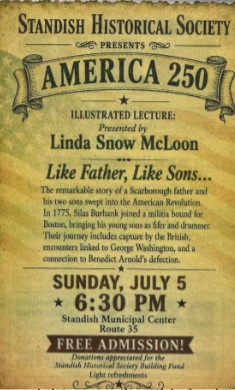
I was dumbstruck. I knew right away that this had to be the same Silas Burbank, but had not yet learned about him bringing 2 of his young sons along as fifer and drummer.
I wish I had been able to attend this. I’m sure I would have learned more about this remarkable story.
For more information, I turned to one of my much used sources, Soldiers,
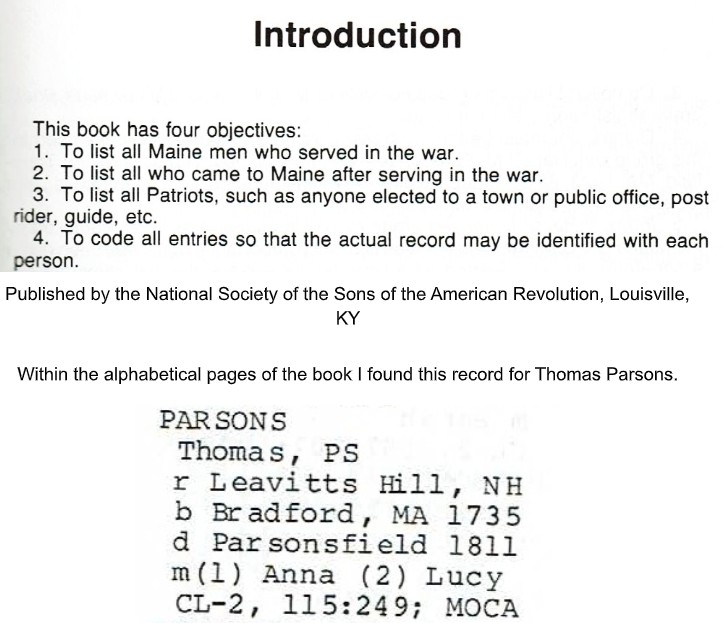
Sailors, and Patriots of the Revolutionary War – Maine. And there his sons were, along with their father’s listing:
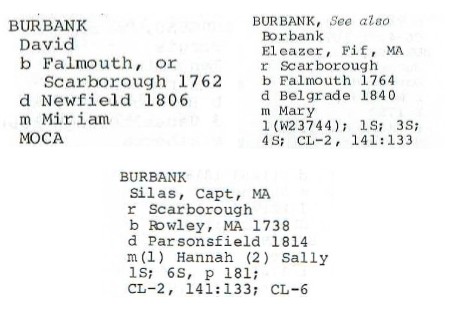
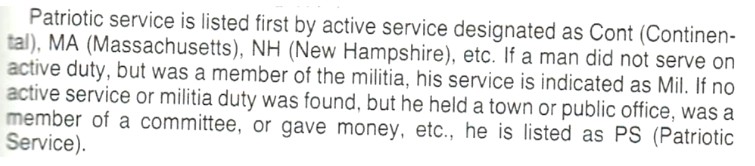
The letters and numbers at the end of these listings are the cited references.
David’s only reference is:
- MOCA (Maine Old Cemetery Association).
Eleazer has several references:
- 1 (W23744) – Massachusetts Soldiers and Sailors of the Revolutionary War 17 v.
- 1S – Massachusetts Archives, Revolutionary War Service Appendix
- 3S – Flagg’s Alphabetical Index of Revolutionary Pensioners Living in Maine
- 4S – Maine State Archives – Names of Soldiers of the American Revolution Who Applied for State Bounty …
- CL-2, 141:133 – Compiled List – Lineage Book, 166 volumes.
Captain Silas also has several references:
- 1S – Massachusetts Archives, Revolutionary War Service Appendix
- 6S, p. 181 – History of Col. Edmund Phinney’s 31 st Regiment of Foot: The First Regiment Raised in the County of Cumberland in the Revolutionary War
- CL-2, 141:133 – Compiled List – Lineage Book, 166 volumes.
- CL-6 – Compiled List – Historical Register of Officers of the Continental Army during the War of the Revolution, April, 1775 – December, 1783.
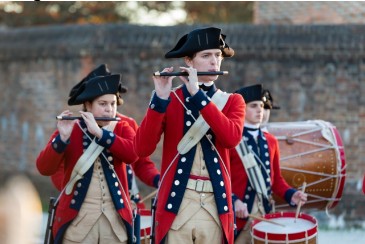
It’s hard with our modern day sensitivities to imagine taking young sons off to war. Perhaps he thought it was the easiest way to watch over them. Many young men, not that much older than 11 and 13, did head off to battle.
Historically, a fifer was a non-combatant military personnel—often a young boy or teenager—tasked with playing the fife alongside drummers to relay orders, maintain a marching pace, and signal troop formations.
Drummer boys in the Revolutionary War were young field musicians (often 10 to 15 years old) who used rope-tension drums to relay tactical commands across loud, smoky battlefields. They set the army’s daily routine, regulated marches, and boosted morale, often serving alongside adult musicians and soldiers.
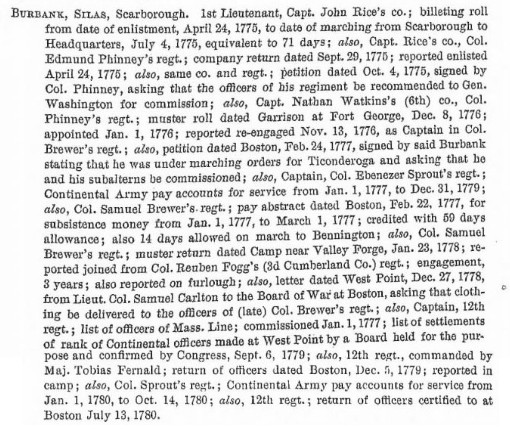
Silas’ listing in the book, Massachusetts, U.S., Soldiers and Sailors in the
Revolutionary War gives a much more complete listing of his service than the Maine one.
Here, from the same source, is his son David’s listing:
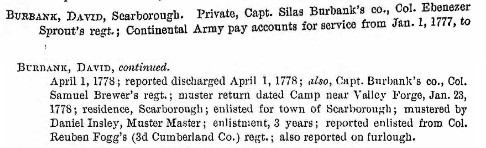
And the listing for Eleazer:
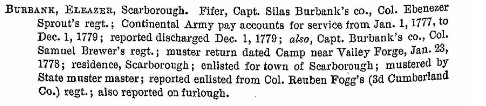
Eleazer enlisted in the army in Scarborough for one year at age eleven and served until August when he was left in Boston with smallpox and sent home. He was a musician, a fifer, in the company of Captain Watkins of the Regt. commanded by Col Phinney in the Massachusetts line. He and his brother, a drummer, served with their father. In January, 1777 he enlisted for 3 years and served in his father, Col. Silas Burbank’s, company in Col. Samuel Brewer’s regiment.
One record on file in Washington states that “Eleazer was captured and held prisoner for a month and when the English soldiers asked him to play for them he responded by playing Yankee Doodle much to their amusement.
He was in the retreat from Ticonderoga, Battle of Fort Ann and at taking of Burgoyne. In Dec, 1780 he was discharged from the military.
Neither of the brothers ended up in Parsonsfield. In 1788 Eleazer married Mary Brackett. He was a farmer and after living in Scarborough for a time, around 1798-99, he moved with a 6 ox team to Belgrade, Maine where he lived out the rest of his days.
His older brother David married Miriam _ and settled in Newfield, Maine
appearing there in the 1800 Census. He died in 1806 at the age of 44, leaving 5 minor sons.
The first of the family to move to Parsonsfield was their younger brother, Samuel, born 1772. He married Esther Boothby and they, along with his father, settled in Parsonsfield sometime around 1805. He was a blacksmith and a carpenter. When his brother David died prematurely, Samuel and Esther were appointed the legal guardians of David’s 5 young sons – this was in addition to raising their own 11 children.
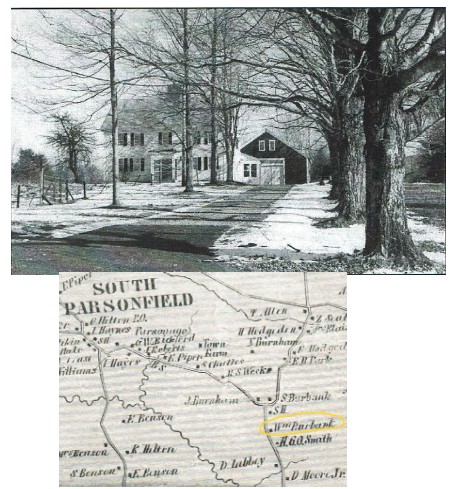
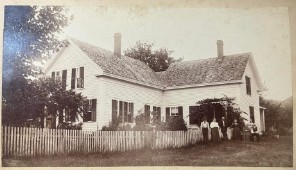
The 1856 and 1872 maps show their home as that of William Burbank, who was Samuel’s youngest son.
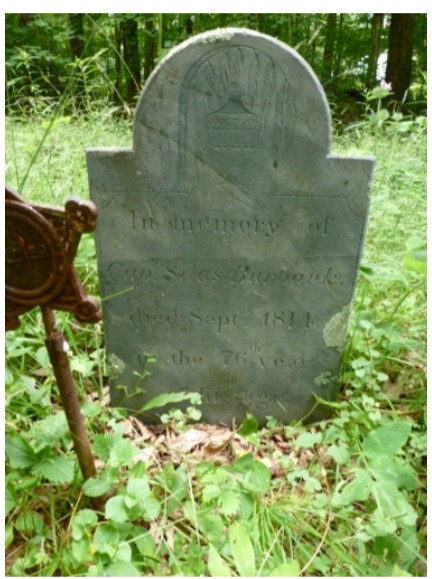
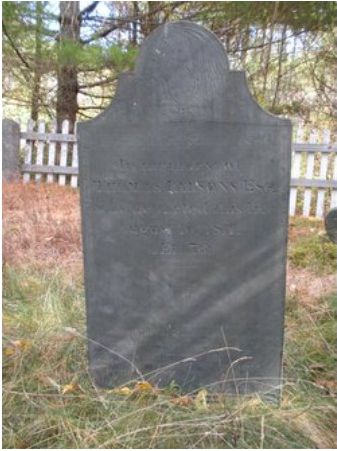
Captain Silas died in this house in September 1814 and was buried in the afore-mentioned cemetery. His tombstone bears a lovely motif of a weeping willow with the following inscription:
In memory of Capt. Silas Burbank
died Sept. 1814 in the 76th yr of his age.