Correction:
Before we tell the story of this month’s soldier we have a correction to last month’s story about John Trueworthy where we reported that:
“The 1790 Census shows his family still residing in Biddeford but they later took up residency in Phippsburg where in 1803 John served as constable and was required to collect taxes of several people in the town.“
Since that time PPHS President, Sylvia Trueworthy Pease, has discovered that our reading of the name of the town in the old document was in error and the name of the town was actually Phillipsburgh.
In the book Saco Valley Settlements and Famiies by Gideon T. Ridlon “The town was incorporated January 27, 1798 by the name of Phillipsburgh, in honor of the first white proprietor.”
“The name of the new town soon became a source of trouble, and a committee of seven wise men was appointed to find a more appropriate designation. Of the name Phillipsburgh it was said: ‘It is too long to write and too hard for the younger ones to pronounce.’ In 1811 the unwieldy name was exchanged for Hollis…The early government seems to have been rather arbitrary, as persons not used to authority are apt to be when in office.”
Perhaps that is why John did not remain in Phillipsburgh because in February of 1807 he bought a parcel of land from Benjamin Rolfe in Parsonsfield. We are grateful that he did.
Now…the 4th in the Series
The featured soldier this month demonstrated remarkable dedication by serving for nearly the entire duration of the Revolutionary War.
Joseph Pearl (Jr) was born in January 1760 to Joseph and Sarah (Bickford) Pearl in Rochester, New Hampshire. The year 1776 brought great changes to his life. His older brother John, born 1753, died in June. Then his mother Sarah passed away on October 9, 1776, in Rochester, New Hampshire, at the age of 39.
The following year, May 1977, he enlisted at Fort Independence in Captain Benjamin Titcomb’s Co. of the 2nd New Hampshire Regiment for a period of three years. He was only 17 years old.
The 2nd New Hampshire Regiment was organized May 1775 from Strafford and Rockingham counties and was commanded by Colonel Enoch Poor, of Exeter. In 1776 it was renamed the 8th Continental Regiment.
In a muster roll dated September 5th Joseph was listed as missing since July 7th and a description of the missing was given, a rarity in military records.
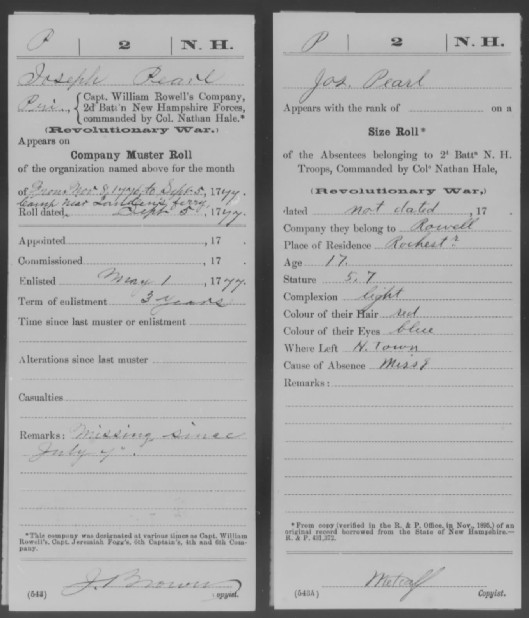
By mid-September Joseph was back with his company and thrust into battle at Saratoga, New York. Of the two battles of Saratoga, known as the Battles of Freeman’s Farm, Bemis Heights or Stillwater, the second battle was the first great victory of the Americans and was deemed by many historians to be the turning point of the Revolutionary War. The victory at Saratoga was significant not only for its immediate military impact but also for its diplomatic consequences. It convinced France to formally recognize American independence and enter the war as an ally, providing much-needed military and financial support.
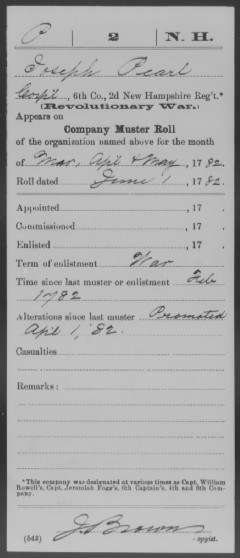
In 1781 Joseph served in Capt. Jeremiah Fogg’s company, 2 nd New Hampshire Regiment and in the following year was promoted from Private to Corporal on April 1, 1782.
After the end of the war, Joseph returned home and on November 17, 1783 married Catherine Clark (1762 – 1837) in his hometown, Rochester, New Hampshire, when he was 23 years old. They had ten children in 20 years. While still living in Rochester the following children were born: Mary (1784–1856); Simeon (1786–); Elizabeth (1786–); Benjamin (1790–1830); and Sarah (1792–1877); Perry Diamond (1794–1837); Anna (1796–1861); John (1798–1868); Joseph III (1801–1889); and James C. (1804–).
Joseph was apparently the recipient of bounty land according to this document.
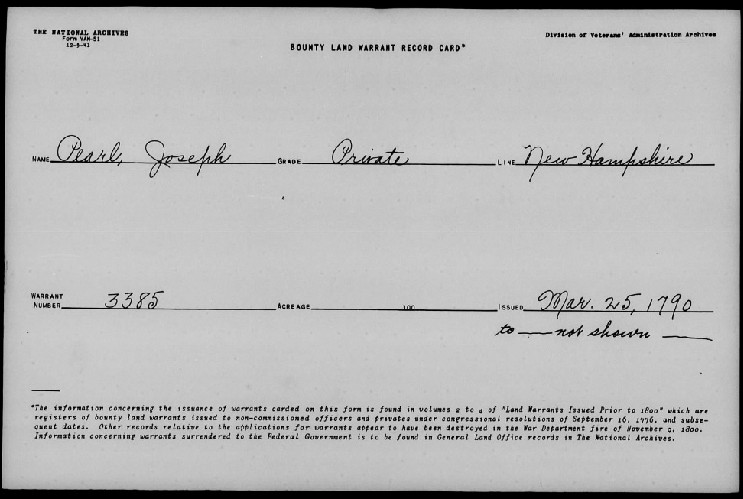
Bounty land warrants were first authorized by the Continental Congress in September 1776 as a way to compensate soldiers for their service during the Revolutionary War, especially when the fledgling nation had limited financial resources. These warrants served both as a reward and as an incentive to encourage enlistment in the Continental Army. The amount of land granted varied by rank.
Whether or not the land granted to him was here in Porter, or if he sold the land granted for cash, he is listed in Thomas Moulton’s “History of Porter, As a Portion of Maine, Its Settlement, Etc.” written 1879 as being a settler in Porter in 1793.
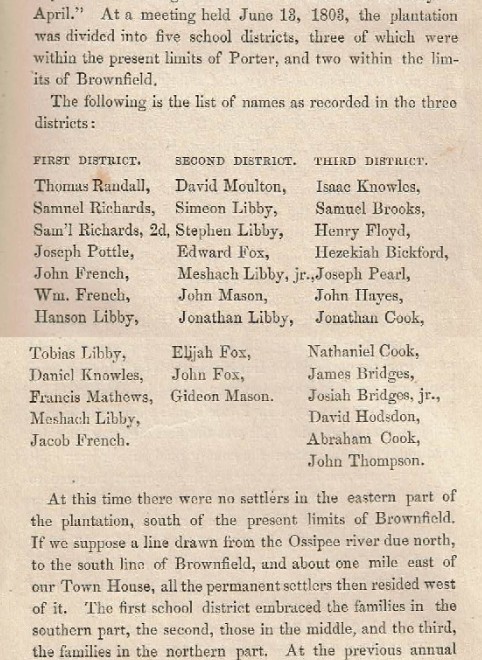
At a plantation meeting in June of 1803 when school districts were laid out, he was listed in School District Three which was described as being in the northern part of the settlement.
We have been unable to locate exactly where his property was, but in 1805 he sold part of the lot to Thomas Cutts of Saco. It is described as being part of lot 12, Range D on the proprietors map which would be in the northwest corner of Porter. The deed states that the conveyance includes the buildings thereon and is where he was currently living on land bought from Benjamin Bickford.
Joseph Pearl died in 1813 in Porter, Maine, when he was 53 years old. Maine Old Cemetery Association gives his burial place as Porter but sadly, beyond that, his final resting place is unknown. Neither is that of his wife, Catherine, who died in Porter in 1837. Our book, “Cemeteries of the Town of Porter, Maine” gives this as a possiblillty.
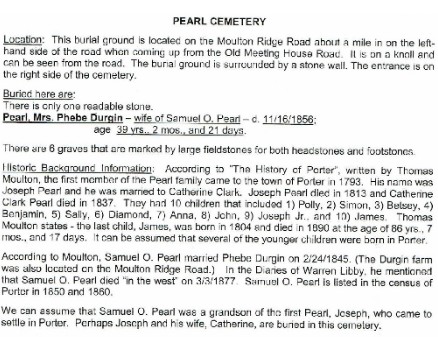
The service of individuals like Joseph Pearl Jr. in the American Revolutionary War exemplifies how ordinary citizens contributed to the struggle for independence.
Life as a soldier during the Revolution was arduous. Troops faced challenging conditions, including irregular pay, scarcity of provisions, and exposure to disease, which often claimed more lives than combat itself. Despite these hardships, the Continental Army and local militias, composed largely of citizen-soldiers, formed the backbone of the American resistance.
For individuals like Pearl, their service represented a profound personal
commitment to the founding of the new nation. Their experiences, shared by thousands, helped to forge a collective identity and laid the groundwork for the civic responsibility that characterized the early American republic.
A Heartfelt Thank You to Joseph Pearl
for his Service in the Founding of Our Country