Sixth in the Series: James Brown
Born in Prince William County, Virginia March 6, 1758, according to
the Maine Old Cemetery Association, James Brown is the only
Revolutionary War veteran from one of the southern colonies to settle in
either Porter or Parsonsfield that we are aware of.
In his sworn affidavit when he applied for a pension in 1819 he made
the following testimony which is transcribed below:
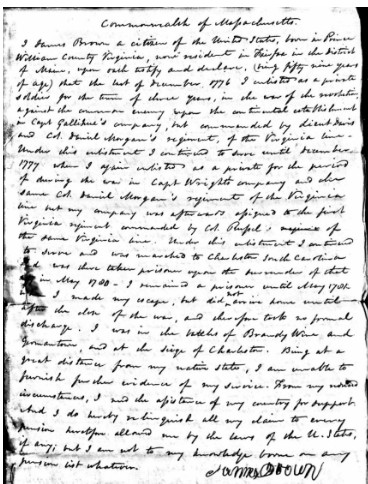
Commonwealth of Massachusetts.
I James Brown a citizen of the United States, born in Prince William County Virginia, now resident in Fairfax in the district of Maine, upon oath testify and declare, (being fifty nine years of age) that the last of December 1776 I enlisted as a private soldier for the term of three years, in the war of the revolution, against the common enemy upon the continental establishment in Capt Gallihue’s company, but commanded by Lieut Davis and Col. Daniel Morgan’s regiment, of the Virginia line. Under this enlistment I continued to serve until December. 1777 when I again enlisted as a private for the period of during the war in Capt Wrights company and the same Col. Daniel Morgan’s regiment of the Virginia line but my company was afterwards assigned to the first Virginia regiment commanded by Col. Ruppel. officers of the same Virginia line. Under this enlistment I continued to serve and was marched to Charleston South Carolina and was there taken prisoner upon the surrender of that in May 1780 – I remained a prisoner until May 1781. I made my escape, but did not arrive home until after the close of the war, and therefore took no formal discharge. I was in the battles of Brandy Wine and Germantown, and at the siege of Charleston. Being at a great distance from my native state, I am unable to furnish further evidence of my service. From my noted circumstances, I need the assistance of my country for support. And I do hereby relinquish all my claim to every pension heretofore allowed me by the laws of the U. States, if any; but I am not to my knowledge borne on any pension list
whatever. James Brown Commonwealth of Massachusetts. Hancock ss.
On the eighth day of May 1819. James Brown above named, after being
carefully examined, made oath to the truth of the above declaration, by him subscribed. Before me, Nathan Weston Jun C. Justice C.C.C. Pleas & C. Circuit.
Summary of His Service
- December 1776 – December 1777: Capt. Gallihue’s co.,Col. Daniel Morgan’s Regiment of the Virginia line.
- December 1777: Re-enlisted for period of “during the war.” Capt. Wright’s co., Col. Daniel Morgan’s Regiment.
- Fought in two battles of the Philadelphia Campaign as the Continental Army under George Washington attempted to regain control of that city.
- Battle at Brandywine, PA September 11, 1777; More troops fought at Brandywine than at any other battle of the American Revolution. It was also the second longest single-day battle of the war, with continuous fighting for 11 hours.
- Battle at Germantown, PA October 4, 1777; part of the Philadelphia Campaign.
- Was taken prisoner in May 1780 when the city fell to the British at the Siege of Charlestown, South Carolina and was held until his escape a year later in May 1781.
The siege of Charleston was a major engagement and major British victory in the American Revolutionary War. It was fought in
the area of Charles Town (today Charleston), between March 29 and May 12, 1780. The British, following the collapse of their northern strategy in late 1777 and their withdrawal from Philadelphia in 1778, shifted their focus to the North American Southern Colonies. After approximately six weeks of siege, Major General Benjamin Lincoln, commanding the Charleston garrison, surrendered his forces to the British. It was one of the worst American defeats of the war.
According to the record below from the book, “Soldiers, Sailor, and
Patriots of the Revolutionary War, Maine edition”, he was married to Lydia ____.
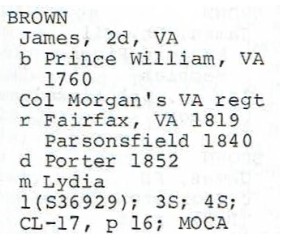
But his listing by the Maine Old Cemetery Association gives us his wife’s
maiden name as well – Lydia Woodman. We have been unable to locate a
record of their marriage or any information about his wife. We have to
assume that she wasn’t with James when he came to Maine. What
brought him to Maine, or when he first arrived, we have no idea, but once
here, here he remained for the rest of his life.
What we do know is that:
- he was living in the town of Fairfax, now Albion, District of Maine in 1819 when he applied for a pension;
- he appears in the 1840 census in Parsonsfield in the household of Edmund Chase where he is listed as a veteran;
- in the 1850 census he was still living in Parsonsfield in the same household now headed by Elizabeth Chase, widow of Edmund Chase. He is listed as a pensioner and, in answer to what his infirmity is, the answer given is blind. Whether totally or partially blind we do not know.
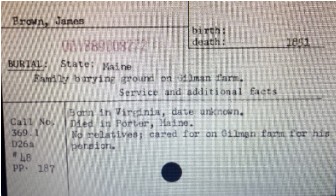
At the time of his death on January 18, 1852 at the age of 93 he was
living on the multigenerational Jacob French/Jesse Bickford farm (later
known as the Gilman farm) in Porter where he was being cared for in
exchange for his pension according to the burial record below.
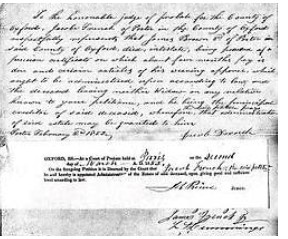
The owner of the farm where he had been living applied for the back pay
which was owed to James at the time of his death.
Jacob French and Jesse Bickford were direct ancestors of our former
longtime member, Dorothy Gilman who married Clayton Locke, another
longtime member and former President of our historical society. The house still remains in the family, now owned by their daughter Patricia Locke Parker.
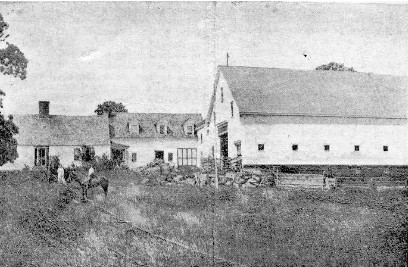
The land was purchased in 1794 by John French and the original part of
the home (a log cabin) was built in 1804.
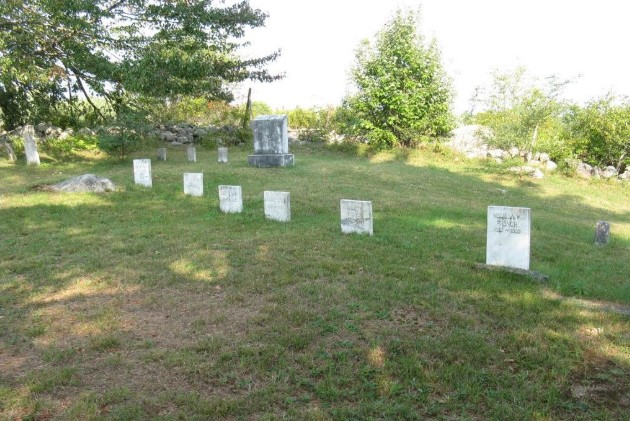
James’ final resting place is in the back right corner of the French-
Gilman cemetery. His grave is a field stone marker with a flag for a
Revolutionary War soldier, still being cared for by descendants of Jesse
Bickford.